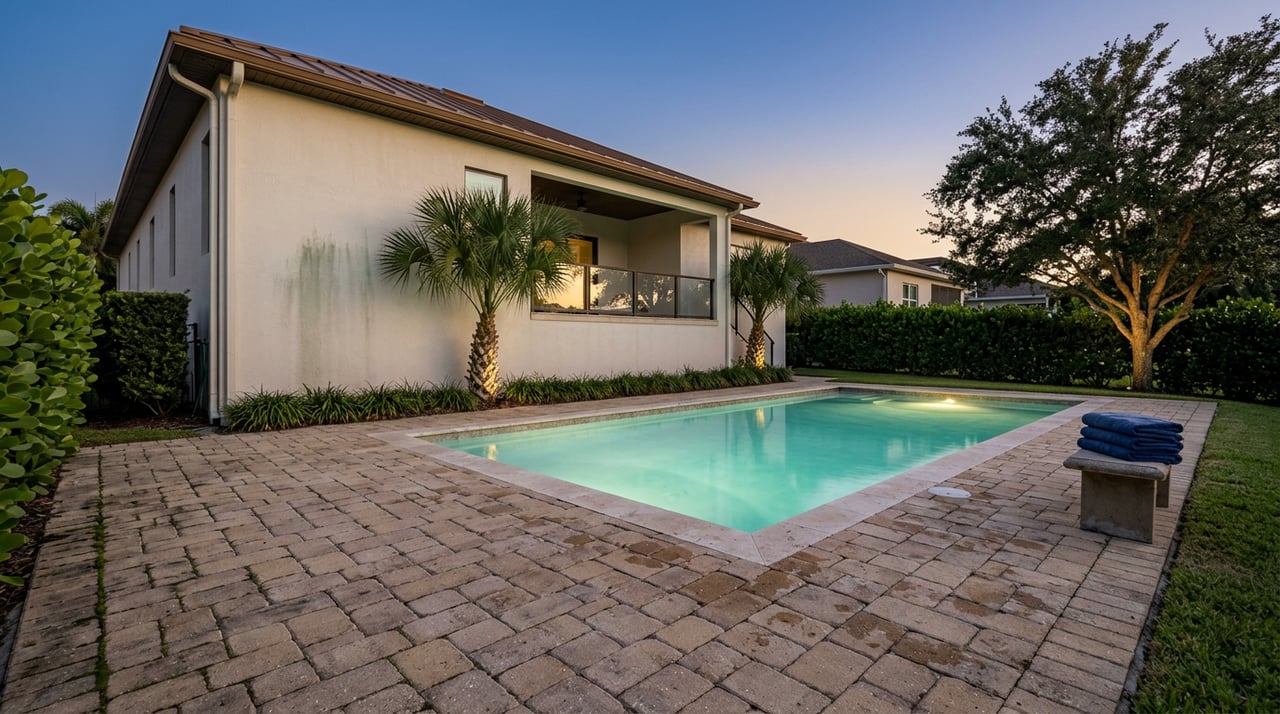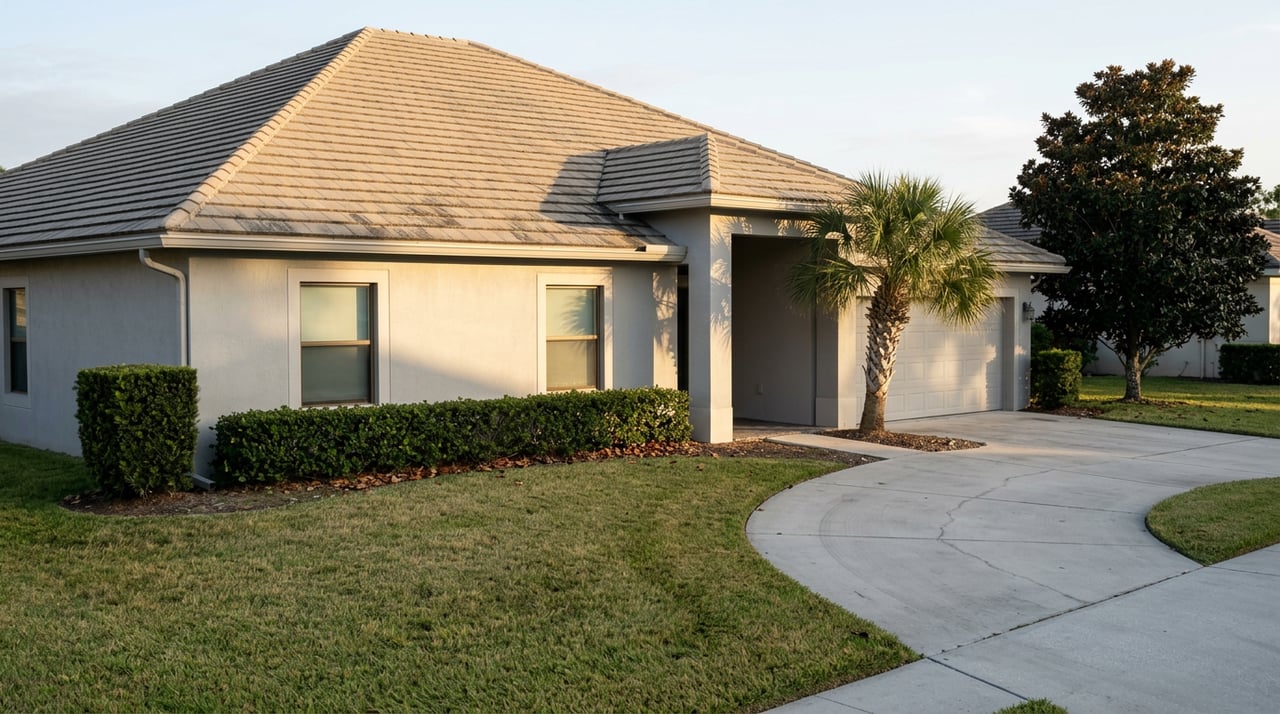
A Jacksonville insurance agency ran the numbers on two homes it insures in the same 32259 zip code earlier this year. Both carry roughly $450,000 in dwelling coverage. Both sit in ordinary Julington Creek Plantation neighborhoods. One was built in 2019 with a hip roof, an impact-rated garage door, and current code construction. Its owner pays under $2,100 a year. The other was built in 1994, frame construction, with a shingle roof installed in 2012. That owner pays over $3,900. Same coverage. Same general area. Nearly $1,800 a year apart, or roughly $18,000 over a decade if nothing changes.
That gap has nothing to do with which entrance you drive through or how close you are to the Sportsplex. It comes down to a single fact buyers routinely skip past on the listing sheet: the year the house was built.
One Neighborhood, Three Decades of Construction
Julington Creek Plantation reads like a single community on a map, but it was never built in one pass. Construction started in 1994 and continued into 2023, spreading across more than 4,000 acres and dozens of named sections, from the original Plantation-area tracts to Cimarrone, Aberdeen, Worthington Park, Bartram Plantation, Celestina, and River Oaks Plantation. The community now holds nearly 5,800 homes, and a house in one section can be thirty years older than a house a half mile away in another.
That span matters more in 2026 than it did five years ago, because Florida's insurance underwriting has gotten far more precise about age. Carriers no longer size up a neighborhood. They size up a roof permit date, a panel brand, and a building code year. In a community that spans three decades of construction, that means two houses with the same square footage and the same asking price can carry very different true costs of ownership, and the difference shows up every year, not just at closing.
The Line Is 2002, Not the Subdivision Line
Florida's modern building code took effect in 2002, and it requires meaningfully stronger wind resistance, roof-to-wall connections, and opening protection than what builders were using in the 1990s. Homes built after that date routinely qualify for better wind mitigation credits and lower base premiums for that reason alone.
Julington Creek Plantation's earliest sections, built from 1994 through the early 2000s, predate that code. That does not make those homes unsafe or uninsurable. It does mean an insurer evaluating one of those houses is working from a different baseline than it would for a home built in Celestina or a newer pocket of Worthington Park in the 2010s or 2020s. A buyer comparing a 1998 resale against a 2015 resale at the same price point is not comparing two versions of the same insurance risk. They are comparing pre-code and post-code construction, and the premium reflects that.
The Four-Point Trigger Has Arrived for JCP's Oldest Sections
Florida's four-point inspection, which examines roof, electrical, plumbing, and HVAC, is not required by state law. It is required by individual carriers, and Citizens Property Insurance Corporation, the state's insurer of last resort, mandates one on any personal residential application for a home more than 20 years old. Most private carriers set a similar threshold.
Do the arithmetic on Julington Creek Plantation's build years and the implication is direct: homes finished in 1994 through roughly 2006 have already crossed, or are crossing, that 20-year line. A buyer under contract on one of those homes should expect a four-point inspection to be part of the insurance process, not an optional extra.
There is a second layer worth knowing. Florida law has protected roofs under 15 years old from age-based denial since 2022, and insurers must still offer coverage on an older roof if a licensed inspector certifies at least five years of remaining life. Going into 2026, several carriers have also started loosening their four-point thresholds, pushing the requirement out to 25 or even 30 years instead of the old universal 20-year cutoff. That is genuinely good news for owners of JCP's original sections, but it varies by carrier, which means the honest answer to "will this house pass" is still "ask the specific company you are applying with."
Here is how the two build eras stack up on the factors that actually move a quote:
| Factor | Homes built 1994 to 2001 | Homes built 2010 and later |
|---|---|---|
| Building code era | Pre-2002 Florida code | Post-2002 Florida code, stronger wind standards |
| Four-point inspection | Required by most carriers | Not typically requested |
| Roof age exposure | Likely on a second or third roof | Usually original roof, well under 15 years |
| Wind mitigation credit | Depends on documented upgrades | Often qualifies automatically |
| 2026 carrier flexibility | Improving, but carrier-dependent | Rarely an issue |
The CDD Fee Doesn't Move. The POA Might.
Buyers often assume the community's development district fee is where the cost differences hide. In Julington Creek Plantation, it mostly is not. The Julington Creek Plantation Community Development District, formed on August 15, 1994 under Florida's Chapter 190 special district law, sets one flat rate per dwelling type regardless of when the house was built. In the district's most recently published assessment schedule, that rate is $1,385.44 a year for a single-family home and $845.57 for multi-family or townhome units, collected on the property tax bill. A 1996 home and a 2021 home pay the same CDD line if they are both single-family.
The confusion buyers run into online is real, though. Some sources describe Julington Creek Plantation as a low-CDD-fee legacy community, others describe it as having no modern CDD at all. The district's own FAQ resolves it: the CDD covers most, but not all, of Julington Creek Plantation, plus all of River Oaks Plantation. A handful of neighborhoods that existed before the district was created voted not to join, which means those owners skip the CDD assessment but also do not get automatic access to CDD-run amenities without paying a separate club membership.
What does vary by sub-neighborhood is the Property Owners Association, a separate entity from the CDD that handles covenants, architectural review, and neighborhood-level upkeep. POA dues differ from section to section depending on gate access and landscaping scope, so two homes with identical CDD assessments can still carry different total dues once the POA line is added. That variation is worth asking about directly rather than assuming, since it is set at the sub-neighborhood level and is not published in one central place the way the CDD assessment is.
What This Means Before You Write an Offer
If you are comparing two Julington Creek Plantation listings priced within a few thousand dollars of each other, the sticker price is not the whole comparison. Ask for the roof's permit date, not just its age as described in the listing. Ask whether the home has had a four-point or wind mitigation inspection in the past year, and if not, budget for one before you apply for coverage. Get an actual insurance quote against the specific address rather than a neighborhood average, because a 1994 home two streets from a 2015 home can price thousands of dollars apart even at the same purchase price.
None of this means older Julington Creek Plantation homes are a bad buy. Many owners of pre-2002 homes have already replaced the roof, updated the panel, and documented wind mitigation features that bring their premium back in line with newer construction. The point is that the paperwork proving it needs to exist before closing, not after a renewal notice arrives.
A short FAQ
Does every home in Julington Creek Plantation need a four-point inspection? No. The requirement generally kicks in around the 20-year mark for most carriers, so it applies mainly to homes built through the mid-2000s. Newer construction in sections built in the 2010s and 2020s typically will not trigger one.
Is the CDD fee different depending on which section I buy in? No. The Julington Creek Plantation CDD sets one rate for single-family homes and one for multi-family or townhome units, applied the same way across the district regardless of build year. What varies by section is the separate POA fee.
Can a 1994 Julington Creek Plantation home still get insured in 2026? Generally yes, especially with a documented roof replacement or a passing wind mitigation report. The market has loosened this year, with some carriers pushing four-point thresholds out to 25 or 30 years, but approval still comes down to the specific carrier and the home's documented condition rather than age alone.
If you are weighing a Julington Creek Plantation resale against a newer build elsewhere in St. Johns County, or trying to figure out what a specific address will actually cost to insure before you write an offer, Laura Worrell can walk through the build year, the CDD and POA numbers, and what to ask your carrier before you're under contract. Request a Consultation to start with the specific address you're considering.